
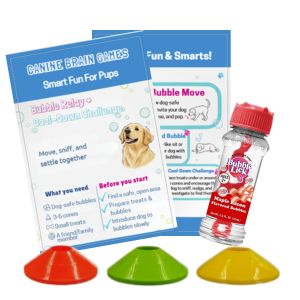
Bubble Relay + Cool Down Challenge

Goal
Build safe, low-pressure movement + focus using bubbles as a “moving target.” Great for rainy days, confidence building, and adding a little joy to your enrichment menu.
What you need
- Dog-safe bubbles (pet-safe solution only)
- A non-slip, open space (rug, yoga mat, or carpet is ideal)
- Optional: treats for breaks/rewarding calm observation
Safety first (quick checklist)
- Use pet-safe bubbles and blow away from your dog’s face.
- Avoid slippery floors (wet bubbles + tile = wipeouts).
- Keep sessions short and stop if your dog is getting frantic, mouthy, or stressed.
Game 1: Bubble Chase
Accordion Panel
- Blow 1–2 bubbles a few feet away.
- Let your dog watch.
- If they pause and observe (even for a second), calmly say something like “Nice!” and toss a treat on the ground to keep arousal low.
You’re teaching: bubbles can be interesting without needing to explode into chaos.
Step 2: Invite a Gentle Chase
- Blow a small cluster of bubbles moving away from your dog.
- Encourage with a soft cue like “Get it!” or “Bubbles!”
- Let them chase and pop at their own pace.
If your dog is hesitant: make it easier—blow fewer bubbles, closer to the ground, and farther away from their face.
Step 3: Add movement patterns
Pick one pattern per session:
- Side-to-side: blow bubbles left, then right to encourage turning and body awareness
- Follow-the-leader: walk slowly and blow bubbles ahead of you so your dog tracks and follows
- Up/down levels: blow some low near the floor, then a few higher (only if your dog isn’t jumping wildly)
Keep it smooth and slow—this is enrichment, not a sprint.
Step 4: Reset Breaks
Every 20–40 seconds, pause:
- Ask for a simple behavior like “Find it” (scatter 3–5 treats) for a sniff break
- Then restart with a small bubble set
This prevents: overstimulation and keeps the game sustainable.
Change the Challenge Level
Easier
- Fewer bubbles, slower pace
- Treat for watching calmly
- Play in a smaller space with less running room
Harder (only if your dog stays regulated)
- Add a cue: “Wait… okay!” before you blow bubbles
- Alternate: bubbles → “find it” → bubbles
- Ask for a quick behavior between sets (touch, hand target, spin)
When to stop
End the game if you see:
- frantic snapping, coughing/gagging, or repeated bubble-solution licking
- slipping, wild jumping, or zoomies that don’t settle
- stress signs (whale eye, lip licking, backing away)
Best finish: 1 easy bubble set → “all done” → sniffy treat scatter.
Game 2: Sit! And Bubble
Step 1: Set the rules (no bubbles yet)
- Ask for Sit.
- Mark/reward (or calmly praise) for success.
- Do 2–3 reps so your dog is in “training mode,” not “CHASE MODE.”
Why: If bubbles appear too soon, many dogs can’t think.
Step 2: Add the “release word” (still no bubbles)
- Ask for Sit.
- Pause 1 second.
- Say your release cue: “Get it!” (or “Okay!”)
- Toss a treat forward on the ground.
Step 3: Pair release with bubbles (the game)
- Ask for Sit (or Stay if your dog already knows it).
- Hold bubbles ready but don’t blow yet.
- Count 1–2 seconds of success.
- Say “Get it!”
- Immediately blow 2–4 bubbles out in front of your dog.
Let them chase/pop, then pause.
Step 4: Reset Breaks
After each bubble set:
- Scatter 3–5 treats (“find it”) or
- Ask for a calm sit and reward
Then repeat for 3–6 rounds total.
Common problems + fixes
“My dog breaks the sit as soon as they see the bubbles”
- Make it easier: sit → treat (no bubbles) a few reps
- Then: sit → release → bubbles with only 1 second of waiting
- Hide bubbles behind your back until the sit happens
“My dog gets too wild / mouthy”
- Use fewer bubbles
- Reward watching bubbles instead of chasing
- Do: sit → release → sniff scatter (skip bubbles for a round) → bubbles again
“My dog doesn’t care about bubbles”
- Try blowing bubbles lower and closer to the ground
- Pair with a treat toss after the release so it’s still rewarding
- Use the bubbles as a “visual cue” while the treat is the payoff
Game 3: Cool Down Challenge
Quick tips (so it works for real life)
Where to store it
Keep the scented toy in a sealed bag or container so the scent stays strong and it doesn’t “perfume” your whole house.
How often to use it
- Great for post-walk decompression
- Great for rainy days
- Great as a cool down after higher-energy play
If your dog tries to chew it
That’s info, not “bad behavior.”
-
- Hold the toy, reward sniffing, then put it away
- Use it as a “sniff target,” not a chew item
- If you want, I can write a “chewers” modification blurb
Step 1: Show them the game
- Let your dog watch you place 1 treat next to a cone.
- Release with a calm cue: “Find it.”
- When they get it, quietly praise and place the next treat.
Do 3–5 quick reps so they understand: cones = sniffing pays.
Step 2: Hide treats under the cones
- Place a treat on the floor.
- Put a cone over it (so it’s easy to tip or nudge).
- Say “Find it.”
- Let your dog sniff, nudge, paw, or tip the cone to access the treat.
If they struggle, lift the cone slightly so they get the idea, then try again.
Step 3: Add “around + under” (the challenge)
-
Create a mix:
- 1–2 treats under cones
- 2–4 treats around cones (near the base)
- Optional: a “blank” cone with no treat (later, for difficulty)
Release: “Find it” and let them work.
Step 4: End with a calm finish
When most treats are found:
- Scatter the last 3–5 treats in a small area and say “All done”
- Or invite a settle on a mat with one final treat
Change the Challenge Level
Easier
- Keep treats visible (around the cone, not under)
- Use higher-value treats
- Keep cones closer together so scent is stronger
Harder (cool-down appropriate, not frantic)
- Add more cones (6–10)
- Add 1–2 “empty” cones
- Place treats partially under the edge instead of centered
- Increase distance between cones so they have to search
Troubleshooting
“My dog tries to grab/chew the cone”
- Use heavier cones or swap to sturdy bowls
- Reinforce sniffing: treat for nose touches before they mouth it
- Keep sessions short and supervised
“My dog gets frustrated”
- Make the next rep easier (treat beside cone)
- Help once, then let them succeed quickly
“My dog is still too hyped”
- Start with a treat scatter first, then cones
- Use calm delivery: slow movements, quiet voice, fewer reps
